Eladovar
01 — NUTRITIONAL FRAMEWORK

Plan.Source.Nourish.

A structured reference for whole-food nutrition, developed for professionals whose schedules compress the window available for deliberate meal preparation. Each framework is built around ingredient traceability, macronutrient calibration, and realistic batch-cooking protocols.

Whole-Ingredient Sourcing
Batch-Cook Protocol
Nutrient-Density Index
UK-Sourced Ingredients
Macronutrient Calibration/// Whole-Ingredient Sourcing/// Batch-Cook Protocol/// Seasonal Composition/// Gut-Friendly Fermentation/// Pantry Architecture/// Circadian Meal Timing/// Portion Calibration/// Phytonutrient Distribution/// Slow-Fermentation Standard/// Macronutrient Calibration/// Whole-Ingredient Sourcing/// Batch-Cook Protocol/// Seasonal Composition/// Gut-Friendly Fermentation/// Pantry Architecture/// Circadian Meal Timing/// Portion Calibration/// Phytonutrient Distribution/// Slow-Fermentation Standard///
02 — CORE FRAMEWORK

Six Pillars of Structured Eating

All Programmes
01
Meal Prep Protocol

Batch-Cook Architecture for the Working Week

A structured approach to preparing 4–5 days of nutritionally complete provisions in a single two-hour session. The protocol accounts for ingredient overlap, refrigeration windows, and reheating integrity. Each batch sequence is documented as a repeatable step record with gram-level portion calibration.

Batch Coding 2h Window 5 Meal Yield
Systematically arranged batch-cooked whole-food meals in glass containers on a clean wooden kitchen counter, natural light
02
Whole-Food Matrix

Nutrient-Dense Ingredient Selection

Whole-ingredient sourcing prioritises compositionally dense selections — legumes, brassicas, fermented staples, cold-pressed oils — evaluated against glycaemic load, fibre content, and seasonal availability within UK supply chains.

  • Seasonal UK produce calendar reference
  • Phytonutrient distribution guide per vegetable family
  • Fermented staple incorporation protocols
  • Pantry architecture and dry-goods organisation
03
Seasonal Eating

Calendar-Led Composition

Ingredient rotation aligned with the UK agricultural calendar. Spring brassicas through winter roots — each seasonal shift is documented with flavour-pairing logic and macro-substitution tables to maintain balanced intake across all four quarters.

Seasonal Guide
04
Label Reading

Food Label Interpretation Framework

A decision-tree methodology for evaluating packaged goods against ingredient quality, additive presence, serving-size accuracy, and macronutrient profile. Reading food labels precisely reduces hidden-variable intake from pre-processed components.

Reference Format: Rev. 03
05
Gut-Friendly Focus

Fermented & Slow-Cultured Recipes

Fermentation profiles for kefir, miso, sauerkraut, and kimchi at home. Each recipe is accompanied by a slow-fermentation standard that specifies temperature range, salt concentration, and time-to-completion.

Various fermented foods in glass jars arranged on a wooden shelf in a well-lit kitchen — kimchi, sauerkraut, kefir, and kombucha
06
Mindful Eating Habits

Deliberate Composition Over Convenience

Attention to food quality over quantity — a framework that redefines how a busy schedule can still sustain cooking from scratch. Includes shopping-list generation, kitchen flow optimisation, and cognitive-load reduction through structured weekly planning.

Methodology

142
Whole-Food Recipes Documented
4
Seasonal Eating Calendars
38
Batch-Cook Protocols
12
Fermented Staple Formulations
03 — EVIDENCE BASIS

Nutritional Composition as an Engineering Problem

"Whole-food nutrition is not an aesthetic choice. It is a logistical one — the correct selection of raw materials for a system that operates under time constraints."

— Eladovar Reference Archive, 2024

The framework begins with a recognition that most nutritional shortfall in time-constrained professionals is not a knowledge deficit but a preparation-architecture deficit. The individual understands that legumes outperform processed carbohydrates on satiety index. The challenge is making the superior choice structurally easier than the inferior one within a schedule that allows perhaps 40 minutes of kitchen time on a weekday.

Eladovar approaches this as a systems question. What pantry architecture reduces decision latency? Which batch sequences produce the widest variety from the shortest active preparation window? How does ingredient overlap — the double-use of a roasted root across two separate meals — reduce total preparation time without sacrificing macronutrient diversity?

Published nutritional research on Mediterranean-style eating, gut-microbiome diversity, and anti-inflammatory dietary patterns informs the ingredient selection logic. The reference library draws on peer-reviewed nutritional science to build practical, repeatable frameworks — not trend-following, but evidence-based composition principles adapted to the realities of a busy working week.

Neatly arranged seasonal vegetables and whole grains laid flat on a large wooden chopping board in a professional kitchen setting, overhead view
Research Basis

Mediterranean-style eating patterns, microbiome diversity research, glycaemic load assessment, and whole-food composition standards.

UK Context

All protocols are calibrated against UK ingredient availability, seasonal supply windows, and London-market sourcing chains.

04 — PROGRAMMES OVERVIEW

Structured Programmes

Programme A

The Weekly Planner

A seven-day whole-food meal structure with shopping list, batch-cook sequence, and portioning guide. Designed for a single person or couple. Macro distribution targets are documented per day.

Details
Programme B

Seasonal Recipe Archive

A curated collection of 40 whole-food recipes, cross-indexed by season, preparation time, and primary ingredient family. Each recipe includes a nutrient-density annotation and a preparation complexity rating.

Details
Programme C

Pantry & Methodology Guide

A systems document covering pantry architecture, equipment selection, batch-cook scheduling, and ingredient-sourcing standards. Applicable to kitchen environments from studio flats to shared professional spaces.

Details
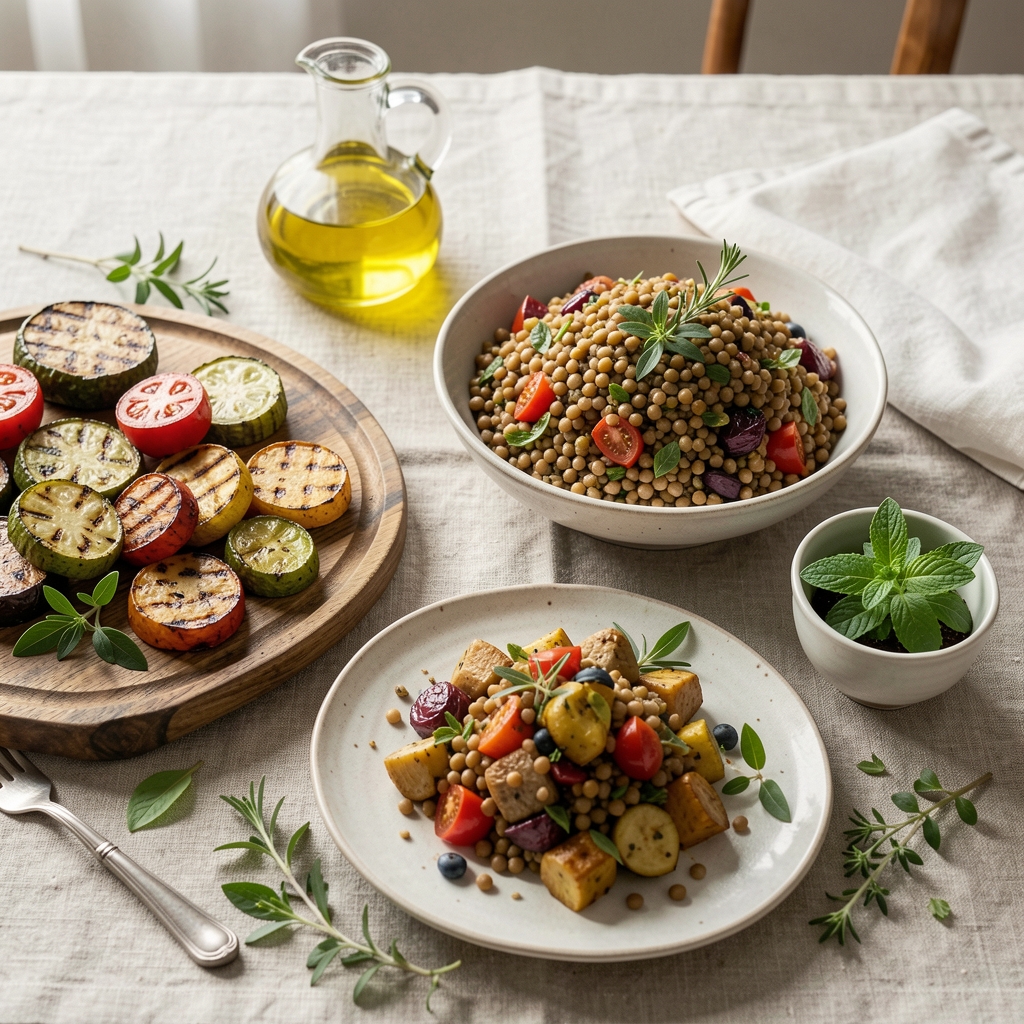
Colourful Mediterranean-style spread with grilled vegetables, lentil salad, olive oil, and fresh herbs on a rustic linen tablecloth, natural daylight
05 — REFERENCE PATTERN

Mediterranean-Style Eating: A Composition Reference

The Mediterranean dietary pattern is one of the most extensively documented whole-food frameworks in published nutritional literature. Eladovar uses its compositional logic — high legume and vegetable density, olive oil as primary fat, limited ultra-processed components — as a structural reference, adapted for UK seasonal availability.

Key composition markers include a plant-to-animal protein ratio greater than 2:1, whole-grain inclusion at each main meal, and daily fermented component intake for gut microbiome diversity maintenance. These markers are measurable within a batch-cook preparation structure without specialist equipment.

2:1
Plant Protein Ratio
7+
Vegetable Portions Daily
Fermented Daily
06 — REFERENCE QUESTIONS

Common Questions

Technical clarifications on methodology, ingredient sourcing, and programme application.

Open spiral-bound meal planning notebook next to a mug of green tea, seasonal vegetable photographs, and handwritten nutritional notes on a desk

Macronutrient calibration is the process of aligning carbohydrate, protein, and fat quantities in a meal plan to documented intake targets. Within the Eladovar framework, targets are derived from published nutritional reference values and adjusted per body mass, activity level, and preparation window available. The output is a portioning guide expressed in grams per serving per meal.

Ingredients are annotated against a phytonutrient index that flags high concentrations of polyphenols, omega-3 fatty acids, and fibre — the three most researched dietary components linked to reduced systemic inflammatory markers in longitudinal nutritional studies. The annotation system uses a three-tier priority coding visible in each recipe card.

No. Plant-based cooking frameworks represent one significant strand within the programme archive, particularly relevant to Mediterranean-pattern and gut-friendly recipe collections. The broader archive includes flexitarian and omnivorous meal plans, with whole-food sourcing and preparation quality maintained as constant standards across all dietary pattern variants.

Slow-cooking protocols are structured around passive preparation time — where the cooking process requires minimal active attention. A 6-hour low-temperature braise, for instance, aligns with a working day when initiated in the morning. The framework documents optimal cut selection, liquid-to-ingredient ratios, and temperature specifications for reproducible results without requiring active presence throughout the process.

Portion awareness in this framework is not a restriction protocol. It is a calibration process — knowing the actual gram weight and nutritional content of a standard serving for each ingredient type, so that meal totals can be constructed deliberately rather than estimated. The programme includes a reference table of common UK ingredients with per-100g macronutrient data and practical serving-size benchmarks.

Label reading proficiency allows a shopper to distinguish between products of similar apparent category — two nominally "wholegrain" breads with substantially different fibre contents, added sugars, or emulsifier profiles. The Eladovar label-reading guide provides a structured assessment sequence: ingredient list order evaluation, serving-size cross-referencing, and additive classification using the standard EU/UK E-number reference system.

07 — NEXT STEPS

Structured Eating Begins with Documentation

Each Eladovar programme is built as a documented reference — a step-record that removes ambiguity from the preparation process. Review the full programme catalogue or contact the Eladovar team to discuss a tailored nutritional framework.